
Cooking Skills
How to Scale a Recipe Without Doubling Every Cooking Detail
2026-10-13 · 6 min read · Kenji Meals
Doubling a recipe gives you twice the ingredients, but it does not give your pan twice the cooking surface. Crowding changes browning, evaporation and the time needed for the centre to cook. Start with serving arithmetic, then make a separate plan for equipment, liquid and doneness. These three recipes show how to turn a larger shopping list into a manageable cooking session.
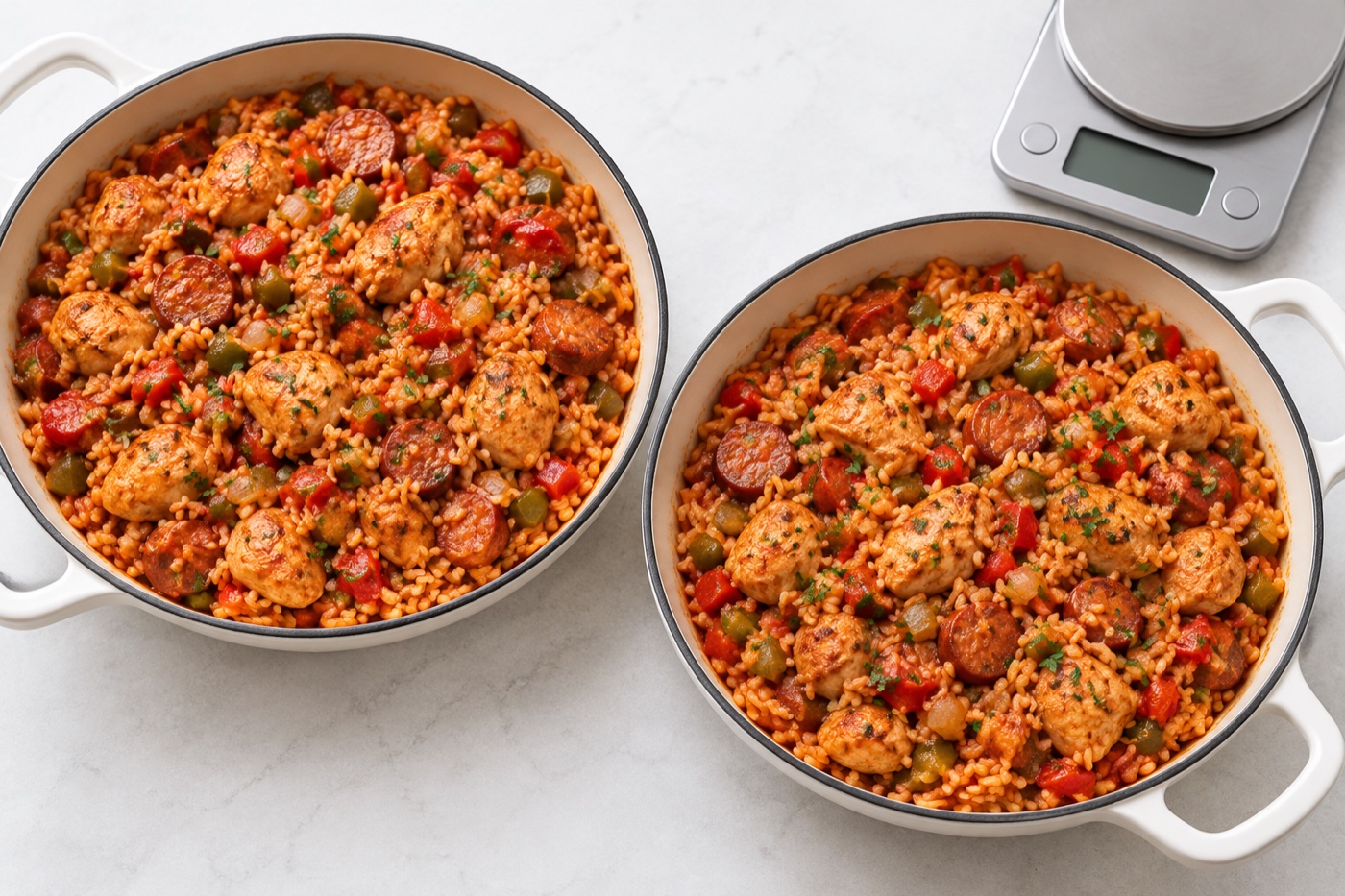
AI-generated editorial illustration.
Calculate the batch before changing the method
Divide your desired servings by the recipe’s listed servings to find the scaling factor. Smoky Chicken & Prawn Jambalaya serves four, so eight servings means multiplying ingredient quantities by two. Six servings means multiplying by 1.5. Keep dry rice measurements separate from cooked rice measurements, and preserve descriptions such as peeled or drained when weighing ingredients.
Write the complete scaled list before starting. Multiply measured spices as an initial plan, while treating salt listed as “or to taste” as adjustable. Stock already contributes seasoning. Oil used for greasing depends on the surfaces you need to coat; the scaled amount is a planning quantity, not a requirement to use every drop.
Check surface area and depth, not just capacity
A pot may hold a double batch without providing suitable cooking space. Doubling food in the same pan increases its depth while leaving the exposed surface roughly unchanged. Chicken has less room for contact with the base, released moisture can accumulate, and a deeper rice mixture can heat unevenly. Leave headroom to stir without spilling.
Two pans comparable to the original give each half of the batch similar depth and cooking surface. One wider pan can also work, but its base needs suitable burner coverage. For a rectangular baking dish, compare internal length multiplied by width: preserving layer depth requires roughly twice the base area for twice the food. A taller dish adds capacity without solving the depth problem.
Plan eight servings of jambalaya in two pans
The doubled jambalaya needs 480g dry long-grain white rice, 800g chicken breast, 600g raw peeled prawns, 800g canned chopped tomatoes and 800ml chicken stock. It also needs 400g green pepper, 300g celery, 300g onion, 18g garlic, 30g olive oil, 8g smoked paprika, 2g dried thyme and 1g cayenne. The listed salt doubles to 2g, subject to taste.
Divide everything evenly between two equivalent pans. Each receives the original quantities: 240g rice, 400g chicken, 300g prawns, 400g tomatoes and 400ml stock, plus half the vegetables and seasonings. Keep chicken pieces at the listed 2cm size. Follow the recipe’s cooking sequence in each pan. If only one suitable pan or burner is available, cook two successive batches and allow for the extra session.
Scale the starting liquid, then observe
Rice needs liquid to hydrate, while some liquid escapes during cooking. Those are different demands. Two similar pans with comparable lids and heat settings preserve the original conditions more closely than one crowded pan. Begin with 400ml stock and 400g tomatoes in each pan; extra water remains an adjustment only if needed.
At the recipe’s checking stage, assess rice from more than one spot. If it remains firm and the mixture is drying, add a small measured splash of hot water, cover and continue cooking. If firm rice still has liquid available, allow further cooking before adding more. Record adjustments separately: different burners, lid seals and tomato consistency can make the pans behave differently.
Use timing as a checkpoint
Do not double cooking time or assume the original time will still apply. A larger total load can take longer to heat, even when divided between pans. Use the recipe’s stated timing to begin checking and maintain its intended cooking heat. Increasing heat to recover lost time can scorch the base before the rice becomes tender.
For jambalaya, check that the rice is tender without a hard centre. Preserve the recipe’s prawn requirement: opaque throughout and at least 63°C internally. Check chicken with a food thermometer; it must reach 74°C, consistent with USDA food-safety guidance. Check several pieces in each pan, especially larger ones. Rice texture, prawn doneness and chicken temperature answer different questions; check all three.
Double egg muffins by adding wells
Cottage Cheese Egg Muffins makes twelve muffins for four breakfasts. For eight breakfasts, plan twenty-four muffins using 16 large eggs, approximately 800g without shells, 600g cottage cheese, 200g spinach, 300g red pepper and 100g cheddar. Allow enough oil to grease twenty-four wells; the doubled listed quantity is 10g. Adjust salt to taste.
Use additional wells of the same size and maintain the original fill level. Putting twice the mixture into twelve wells changes depth and risks overflow. If two tins fit with space for air circulation, bake together and check both; otherwise, refrigerate the waiting mixture and bake in succession. Centres must be fully set, without liquid egg, and reach the recipe’s minimum internal temperature of 71°C. A browned top alone is insufficient.
Keep shepherd’s pie layers comparable
For eight servings of Red Lentil & Sweet Potato Shepherd’s Pie, plan 500g dry red lentils, 1.4kg peeled sweet potato, 300g each of onion and carrot, 500g mushrooms, 300g peas, 60g tomato purée and 1.5 litres vegetable stock. The remaining doubled quantities are 30g olive oil, 12g garlic, 4g smoked paprika and 2g dried oregano, with salt adjusted to taste.
Prepare filling and mash in equipment with stirring room, then divide each equally between two dishes comparable to the original. Keep filling depth and mash thickness similar. Before assembly, check that lentils are tender and the filling has enough body to support the topping. During baking, assess the centre as well as the edges: golden mash does not prove the filling is hot throughout. Check each dish separately.
Make cooling space part of the plan
Before doubling, count the shallow containers and fridge space available. USDA’s Leftovers and Food Safety guidance says to refrigerate perishable food within two hours, or one hour above 32°C, keep the fridge at 4°C or below, and reheat leftovers to 74°C. Its general three-to-four-day maximum does not extend these recipes’ shorter limits: refrigerate egg muffins and shepherd’s pie for no more than three days.
For jambalaya, follow the shorter rice schedule from the Food Standards Agency’s Home Food Fact Checker: cool within one hour, refrigerate, use within twenty-four hours and reheat only once until steaming hot, also reaching 74°C. Divide leftovers promptly into small, shallow portions rather than leaving a large pot on the counter to cool. Storage space, pan capacity and available burners should all influence the batch size you choose.
Recipes to use with this guide
- Smoky Chicken & Prawn Jambalaya — A tomato-based one-pot rice dish with chicken, prawns, peppers and celery, seasoned with paprika and thyme.
- Cottage Cheese Egg Muffins — Spinach, pepper and cottage cheese baked into twelve tender egg muffins for four savoury breakfasts.
- Red Lentil & Sweet Potato Shepherd’s Pie — A savoury lentil, mushroom and pea filling under golden ridges of sweet potato mash.
Sources and further reading
The meal combinations and planning examples are suggestions; follow recipe instructions and product labels for your ingredients.