
Food Storage
How Long Does Meal Prep Actually Last in the Fridge?
You cooked five containers of chicken and rice on Sunday. By Thursday, container four looks fine, smells fine, and you eat it anyway. That's the part most people get wrong about meal prep going bad — it's almost never the container that looks or smells off. It's the one that seems completely normal, three days past when it stopped being safe.
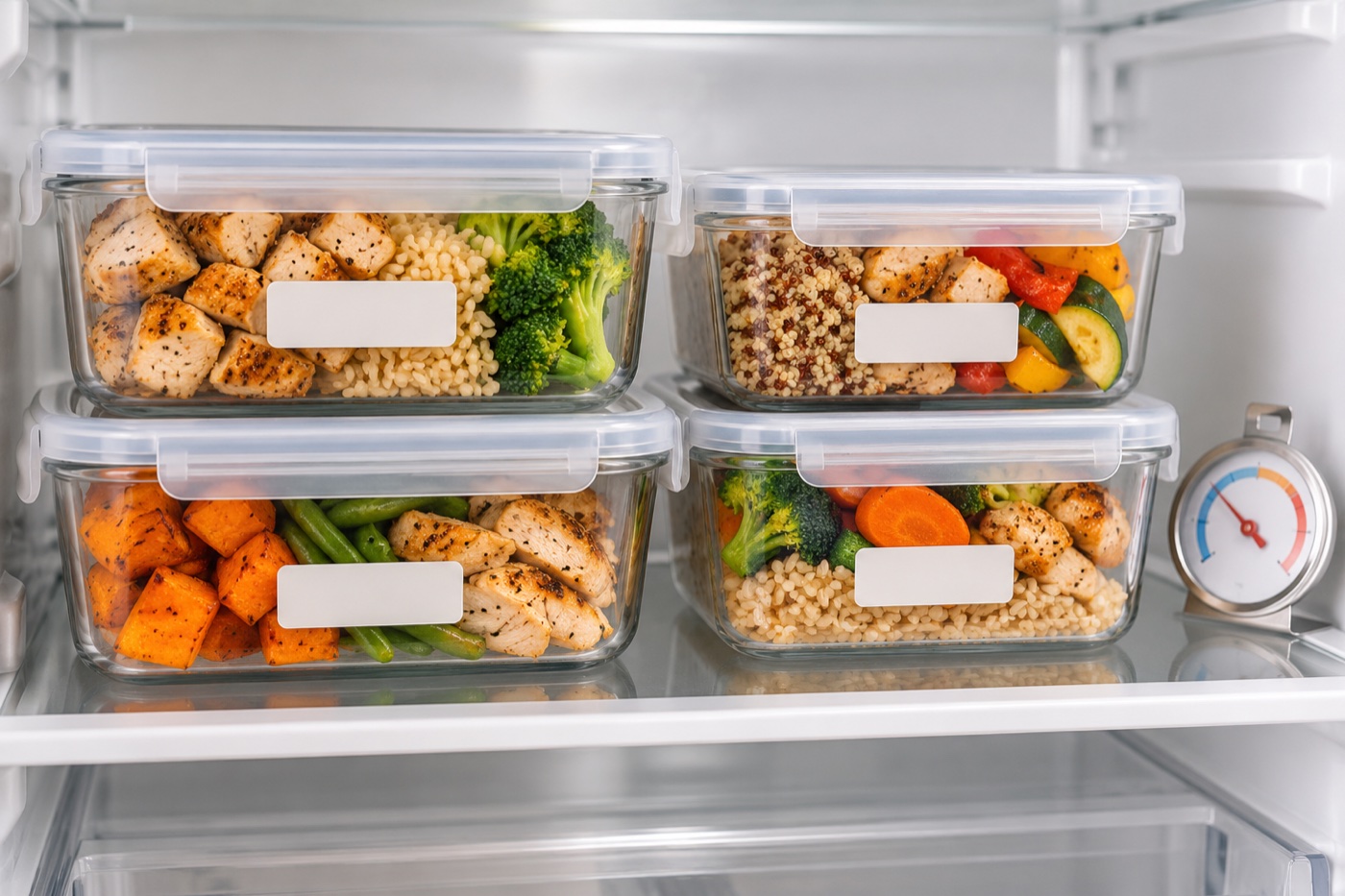
AI-generated editorial illustration.
The real number is 3 to 4 days, not "about a week"
Search around and you'll find people insisting their meal prep is fine on day six or seven. It might be. It also might not be, and there's no way to tell by looking, which is the whole problem. The USDA's actual guidance is that most cooked leftovers are safe for 3 to 4 days in a fridge held at 40°F or below. Not five. Not "until it smells weird." Four days, and that's the outer edge for most cooked proteins and mixed meals — not a conservative buffer you can push past if you're feeling lucky.
The reason the number feels arbitrary is that it isn't based on taste or texture at all. It's based on how fast bacteria like Salmonella, Listeria, and Staph aureus multiply at fridge temperature. They don't grow fast at 38°F, but they don't stop either. Give them four days and the population is still low enough that your immune system usually handles it. Give them six or seven and you're rolling dice with numbers you can't see.
Why "it still smells fine" is the wrong test
This is the part that trips up even careful meal preppers. Spoilage bacteria — the ones that make food smell sour or look slimy — are different from pathogenic bacteria that actually make you sick. Salmonella in particular is odorless, colorless, and tasteless even at concentrations high enough to put you on the bathroom floor for two days. Your nose evolved to detect spoilage, not pathogens. A container of rice and chicken can look and smell identical on day three and day seven while being safe on one and not the other.
That's why "the sniff test" is a decent way to catch food that's gone bad in an obvious way, and a useless way to catch food that's gone bad in the way that actually sends people to urgent care. If you're relying on smell as your main safety check, you're checking for the wrong thing.
The container mistake that's quietly cutting days off your food
Here's the one most people never think about: how fast your food cools before it fully chills matters as much as how long it sits in the fridge afterward. Bacteria multiply fastest between 40°F and 140°F — the "danger zone" — and under good conditions they can double in number every 20 minutes in that range. If you portion hot chicken and rice straight into a deep, tall container and stick the lid on, the center of that container can stay in the danger zone for hours while the outside edges have already cooled. You've just given bacteria a multi-hour head start before the clock even starts on your "4 days."
The fix is unglamorous but it works: use shallow containers, 2 inches of food depth or less, and don't seal them airtight until the food has actually cooled. Let containers sit uncovered on a rack for 20-30 minutes to release steam before refrigerating, then refrigerate promptly — food shouldn't sit at room temperature more than 2 hours total (1 hour if your kitchen is above 90°F in summer). Batch cooking a big pot of chili and splitting it into five deep quart containers the moment it comes off the stove is a common habit that's actively working against you.
The 20-minute rule
Bacteria can double every 20 minutes between 40°F and 140°F. Cool food in shallow containers (2 inches deep or less), get it into the fridge within 2 hours of cooking, and don't stack hot containers directly on top of each other — it slows everyone's cooling down.
Not all prepped food ages the same way
The 3-4 day window is a reasonable default, but it's an average across very different foods. Cooked seafood is the fastest to turn — treat it as good for 2-3 days, not 4. Soups, stews, and chili actually hold up the longest of anything you'll batch cook, often staying safe for 5-6 days because the liquid and reheating-to-boiling process helps. Cooked grains and pasta land in the same 3-5 day range as proteins. Anything with raw leafy greens or a vinaigrette dressing is the shortest-lived item in your fridge, usually best within a day or two before it wilts and turns watery, which is a texture problem before it's a safety one.
| Food type | Fridge life (40°F or below) |
|---|---|
| Cooked chicken, beef, pork | 3-4 days |
| Cooked seafood | 2-3 days |
| Cooked grains, rice, pasta | 3-5 days |
| Cooked vegetables | Up to 5 days |
| Soups, stews, chili | 5-6 days |
| Salads with dressing, leafy greens | 1-2 days |
Reheating doesn't reset the clock, but it does matter
A lot of people assume that if you reheat food thoroughly, you've "killed the bad stuff" and bought yourself more days. Reheating to a safe internal temperature of 165°F does kill most active bacteria in that portion, but it doesn't undo toxins some bacteria have already produced, and it doesn't reset your 3-4 day window for the rest of the batch sitting in the fridge. Reheating is about making today's portion safe to eat right now, not about extending the shelf life of tomorrow's portion.
Use a thermometer if you actually want to know you've hit 165°F — a microwave that "feels hot" often has cold spots in the middle. Sauces, soups, and gravies should come to a full rolling boil. Cover food when microwaving and stir or rotate halfway through so heat distributes instead of scorching the edges and leaving the center lukewarm.
If you're prepping for the whole week, use the freezer as insurance
The real fix for the 4-day ceiling isn't pushing your luck — it's splitting your prep. If you're cooking Sunday for a full seven days, freeze the back half instead of trusting it to survive in the fridge. Most cooked meals freeze well for 2-3 months, with the exception of anything heavy on fresh produce, which turns watery and mushy after thawing. Label containers with the date you froze them (not the date you cooked them originally, if there's a gap) and thaw in the fridge overnight rather than on the counter, which just recreates the danger zone problem you were trying to avoid in the first place.
Let something else track the days for you
Kenji Meals builds your weekly plan around realistic batch sizes, so you're not stuck guessing whether Thursday's portion is still good.