
Meal Prep Techniques
How to Reheat Meal Prep Without Drying It Out
You spent Sunday afternoon portioning out five containers of chicken and rice. By Wednesday, the chicken tastes like a hockey puck and the rice has gone gummy in the middle and crusty at the edges. That's not a meal prep problem. That's a reheating problem, and it's fixable with a splash of water, a lid, and about fifteen fewer seconds of patience than you're currently giving it.
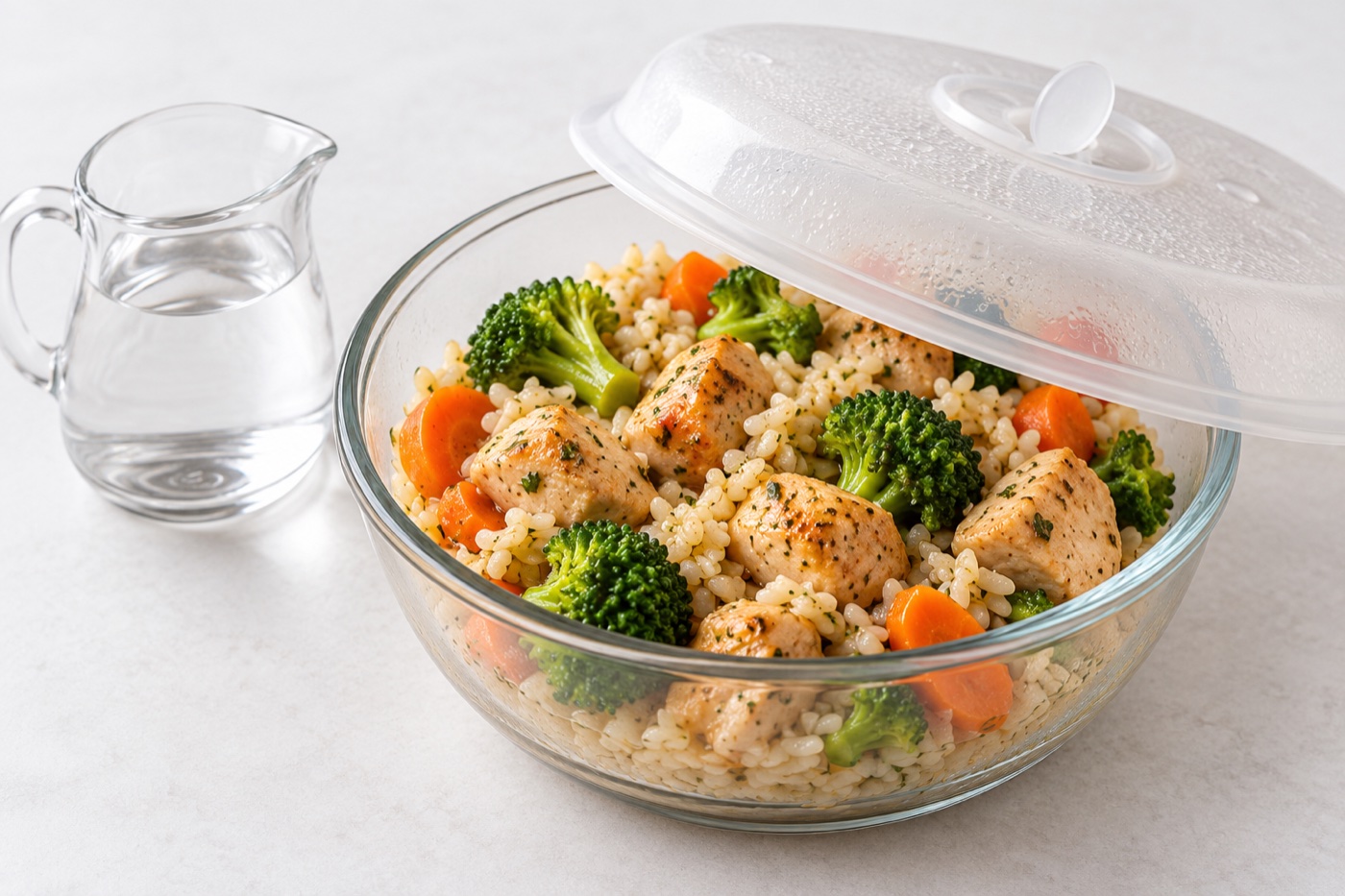
AI-generated editorial illustration.
Why the food dries out in the first place
A microwave doesn't heat food evenly. It excites water molecules, and the water closest to the surface heats and evaporates faster than the water in the center can migrate outward to replace it. That's why a reheated chicken breast can be scalding on the outside and cold in the middle, while the outer half-inch turns to rubber. Above roughly 150°F, muscle fibers in meat contract and squeeze out moisture — the exact thing that already happened once when you cooked it Sunday. Reheat it hard and fast, and you're doing it a second time.
Rice and pasta have a different problem: starch retrogradation. As starchy foods cool, the starch molecules recrystallize and push out water, which is why day-old rice feels harder than fresh rice even before you touch a microwave. Blast it with dry heat and the outside turns to a hard shell while the inside is still cool. Neither of these is a meal prep failure. Both are solved the same way — you're just not giving the food a way to replace the moisture it's about to lose.
Add liquid before you hit start
This is the single biggest fix and almost nobody does it. Before reheating, add a tablespoon or two of water, broth, or leftover sauce directly to the container, then cover it loosely — a vented lid or a paper towel draped over the top, not sealed tight. That liquid turns to steam, and the steam re-hydrates the surface of the food as it heats instead of letting it evaporate into nothing. For rice specifically, splash in a tablespoon of water per cup and fluff it after reheating; for chicken or other proteins, broth works better than plain water because it also carries back some flavor that got left behind in the pan.
A damp paper towel laid directly over the food does double duty: it traps steam close to the surface and it physically shields the food from the microwave's most concentrated heat spots. This one habit alone fixes probably 70% of "why is my meal prep always dry" complaints.
Drop the power to 50%
Full power for 90 seconds is how you get a cold center and rubber edges. Full power blasts the outer layer of food far past done before the heat has time to reach the middle. Cutting your microwave to 50% power roughly doubles the time but lets heat conduct toward the center more evenly, so the whole portion finishes closer to the same temperature at the same time.
In practice: a sliced chicken breast reheated at 50% power takes about 90 seconds instead of 60 at full power, but comes out noticeably more even. For a full container of chicken, rice, and vegetables, that's closer to 2–3 minutes at 50%, stirred once halfway through. Stirring matters almost as much as the power level — it moves the hot outer food toward the cooler center instead of leaving temperature pockets.
Stop fully cooking things on Sunday
Here's the part most guides skip: your meal prep is going to get cooked twice — once when you make it, once when you reheat it. If you cook proteins and starches to fully done on prep day, the reheat step is pure overcooking with nowhere for the extra heat to go except moisture loss. Pull chicken breast off the heat at 155–160°F instead of the usual 165°F target; it'll coast up to a safe temperature as it rests, and the slight undercook gives it room to finish through reheating without turning tough. Cook pasta and rice a notch short of your normal doneness too — al dente, not soft — since both will continue to absorb moisture and soften in the fridge and again during reheat.
This feels counterintuitive if you've spent years being told to cook meat all the way through, but the math is simple: food that's fully cooked once and gently reheated once ends up more done, and drier, than food that's slightly under-cooked once and brought the rest of the way during reheating.
Keep sauce, crunch, and starch apart
Dressings and sauces should live in a small side container, not mixed into the main dish before storage. Sauce sitting on food for four days breaks down textures and, worse, concentrates all its moisture into whatever it's touching — usually turning greens to mush while leaving the protein underneath oddly dry, since the sauce pools rather than coats. The same logic applies to anything meant to stay crisp: nuts, seeds, tortilla chips, or croutons go in separately and get added after reheating, not before.
If your container has rice, protein, and vegetables together, vegetables with high water content — zucchini, broccoli, bell peppers — often finish reheating before the protein does. Reheating everything as one mass means you're choosing between undercooked chicken or mushy vegetables. Splitting dense, slow-to-heat items from fast-cooking ones, even just by pushing them to opposite sides of the container, gives you more control over the final result.
Quick Reference
Add 1–2 tbsp water or broth per portion. Cover loosely, don't seal. Microwave at 50% power in 30-second bursts, stirring halfway. Undercook proteins to 155–160°F on prep day, and stop pasta and rice just short of fully tender. Keep sauces and anything crunchy in a separate container until serving.
The one food safety rule people skip
All of the above only matters if the food is safe to eat, and there's one rule that gets ignored constantly: reheat food to an internal temperature of 165°F, and only reheat it once. Rice is the biggest risk here — it can carry spores of Bacillus cereus, a bacteria that survives cooking and produces a toxin if the rice sits in the "danger zone" (40–140°F) for too long, particularly if it cooled slowly after cooking or sat out before being refrigerated. That toxin isn't destroyed by reheating, which is why the guidance is prevention, not correction: cool rice quickly, refrigerate within two hours, use it within three to four days, and don't reheat the same batch more than once. Every additional reheat cycle is more time spent passing back through the danger zone, which is also the second reason repeated reheating dries food out — it's not just moisture loss, it's cumulative overcooking each time you bring it back up to temperature.
A cheap food thermometer solves the guesswork here. Fifteen dollars gets you certainty that your chicken hit 165°F instead of eyeballing steam and hoping.
| Food | Power | Time | Moisture add |
|---|---|---|---|
| Chicken breast (sliced) | 50% | ~90 sec | 1 tbsp broth |
| Rice | 50–70% | 60–90 sec, stir once | 1 tbsp water per cup |
| Pasta | 50–70% | 60–90 sec, stir once | 1–2 tbsp water or sauce |
| Mixed container (protein + rice + veg) | 50% | 2–3 min, stir halfway | 1–2 tbsp broth, cover loosely |
Meals built to survive the reheat
Kenji plans your week around recipes that actually hold up in the fridge — the right sauces, the right doneness, portioned so day 4 tastes like day 1.