
Nutrition
How to Track Macros for Beginners (Without Losing Your Mind)
Two people eat 1,800 calories a day for eight weeks. One loses fat and keeps their muscle. The other loses weight but ends up softer, weaker, and hungrier than when they started. The difference isn't willpower or genetics — it's what those calories are made of. Macro tracking is how you control that.
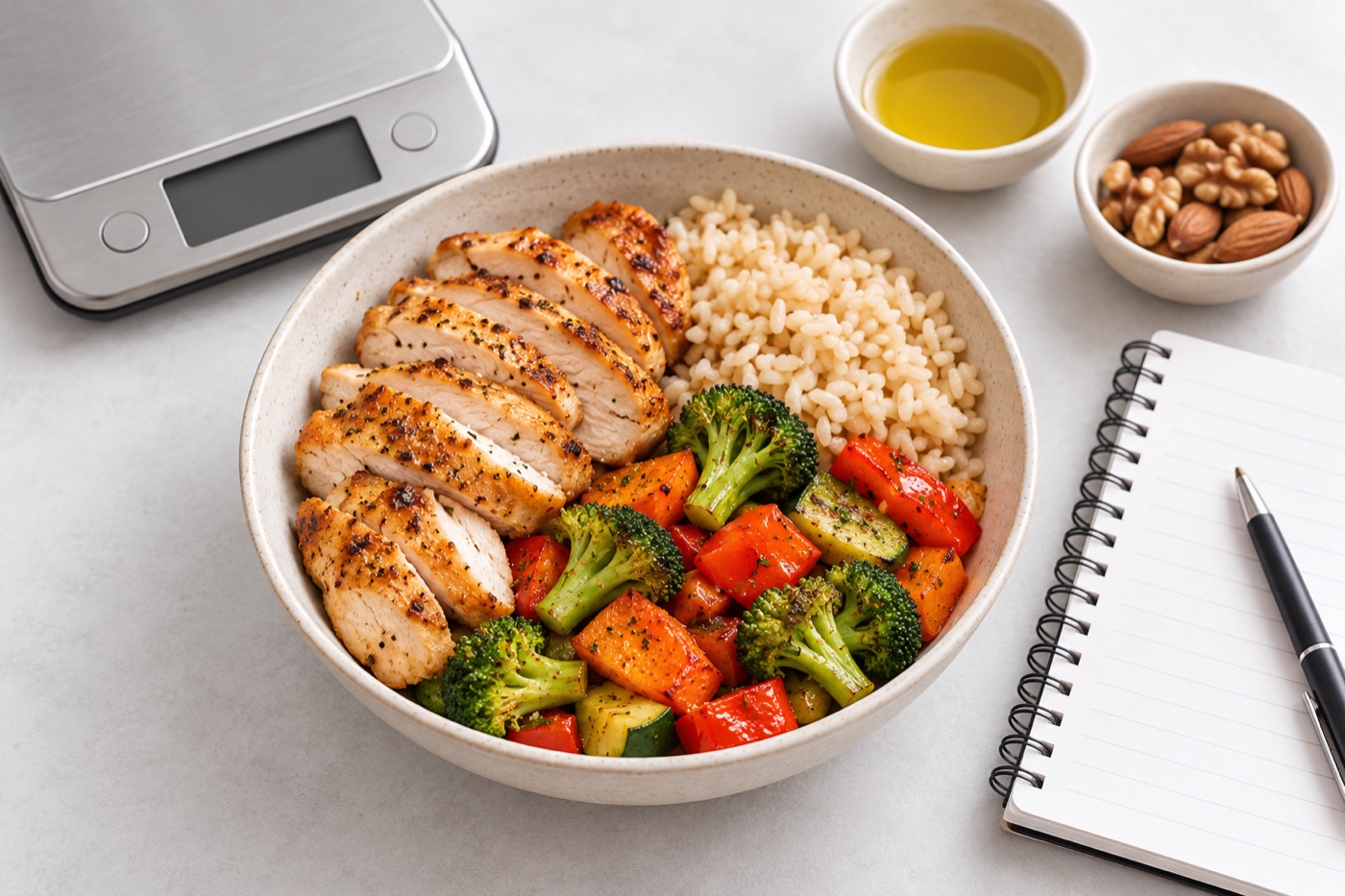
AI-generated editorial illustration.
What macros actually are (and why calories alone miss the point)
Macros — short for macronutrients — are the three categories of fuel your body runs on: protein, carbohydrates, and fat. Every food you eat is some combination of these three, plus water and fiber. Calories tell you how much energy you're eating. Macros tell you what kind.
Here's why that matters: 200 calories of chicken breast and 200 calories of olive oil have almost no overlap in what they do inside your body. The chicken rebuilds muscle tissue, keeps you full for hours, and requires more energy to digest (the thermic effect of protein is around 25–30%, vs. 0–3% for fat). The olive oil is energy-dense, digests quickly, and contributes to hormone production. Neither is better — but knowing the difference lets you use food intentionally.
Most people who "eat healthy" are still guessing at this. Macro tracking makes it precise.
Start with protein, then fill in the rest
The biggest mistake beginners make is treating all three macros equally. They're not equal. Protein is the one that changes your results most dramatically, especially during a calorie deficit. Research consistently shows that higher protein intake — in the range of 1.6 to 2.2 grams per kilogram of bodyweight per day — preserves significantly more lean muscle during weight loss than the default 0.8 g/kg the RDA recommends.
In practice, that means if you weigh 75 kg (165 lbs), you're aiming for roughly 120 to 165 grams of protein per day. That sounds like a lot until you realize 150g of cooked chicken breast delivers about 45g, a cup of Greek yogurt gives you 17g, and two eggs add another 12g. You can get there without eating like a bodybuilder.
Once protein is set, fat and carbs split the remaining calories based on your preferences. A simple starting point for fat loss: 30% protein, 30% fat, 40% carbs as a percentage of total calories. This isn't a law — it's a starting structure you'll adjust over time.
The food scale is not optional
You cannot track macros accurately with measuring cups and eyeballs. This is the part people resist, and it's also the part that explains why so many people track "perfectly" and still don't see results.
Studies on self-reported food intake consistently find that people underestimate what they eat by 20% or more. "A handful of almonds" is 168 calories if it's 28 grams, and 336 calories if it's 56 grams. Both handfuls look roughly the same. "A cup of cooked rice" ranges from 150 to 280 calories depending on how tightly you pack it. These gaps add up to 300–500 hidden calories a day — enough to completely stall fat loss or muscle gain.
A basic digital food scale costs around $12 and sits on your counter. Weigh things in grams. Log the gram weight. That's it. After a few weeks, you'll have a calibrated sense of portions and won't need to weigh everything forever — but you need that calibration first.
The liquids problem nobody warns you about
You can be meticulous about every meal and still miss 300 calories a day. The culprit is almost always drinks. A latte with oat milk: 150 calories, 15g carbs. A protein shake with a splash of peanut butter stirred in: 350 calories, 20g fat. Orange juice with breakfast: 110 calories, 26g carbs. One glass of wine: 125 calories, 4g carbs. None of these feel like "food," so they don't get logged.
Log everything you drink except plain water and black coffee. If you're adding milk, creamer, sweetener, or juice to anything — that goes in the tracker too. This single habit closes the gap for most people who swear they're tracking accurately but not getting results.
How to actually calculate your targets
You need two numbers: your total daily energy expenditure (TDEE) and your macro split. For TDEE, the Mifflin-St. Jeor equation is the most accurate starting point — most calorie calculators use it. Multiply that number by an activity factor (1.2 for sedentary, 1.375 for light activity, 1.55 for moderate), and you have your maintenance calories. Eat at maintenance to recomp, subtract 300–500 calories to lose fat, or add 200–300 to build muscle.
Set protein first: 1.6–2.0g per kg of bodyweight (or 0.7–0.9g per pound). Then allocate 25–35% of remaining calories to fat. Fill the rest with carbohydrates. Recalculate every 3–4 weeks as your weight changes — your targets shift with your bodyweight.
Then apply this to your food. A macro-tracking app handles the math: search a food, enter the weight in grams, done. The key is using the scale and logging before you eat, not trying to reconstruct a meal from memory at 10pm.
A reference table worth bookmarking
| Goal | Calorie target | Protein | Fat | Carbs |
|---|---|---|---|---|
| Fat loss | TDEE − 400 | 35–40% | 25–30% | 30–40% |
| Maintenance / recomp | TDEE | 30–35% | 25–35% | 30–40% |
| Muscle gain | TDEE + 250 | 25–30% | 25–30% | 40–50% |
How long you actually need to track
Macro tracking is a learning tool, not a permanent lifestyle requirement. Most people who track seriously for 8–12 weeks develop a calibrated understanding of food that sticks with them even after they stop logging. You start to know intuitively that your lunch has about 45g of protein, or that the restaurant pasta is probably 90g of carbs.
The goal isn't to log every gram forever. It's to close the gap between what you think you're eating and what you're actually eating — and to stop guessing about why your results aren't matching your effort. For most people, a few months of consistent tracking is enough to make that gap disappear.
The mistake is treating macro tracking as all-or-nothing. Miss a day, log it approximately and move on. Aim for consistency over the week, not perfection every meal. Tracking works on averages — missing Tuesday doesn't erase Monday through Sunday.
Let Kenji handle your macro math automatically
Kenji builds meal plans around your exact protein, carb, and fat targets — so you hit your macros without doing the spreadsheet work yourself.