
Pork Tenderloin Adobo with Garlic Rice
Estimated $11.37 recipe · $3.79 per serving (US / USD)
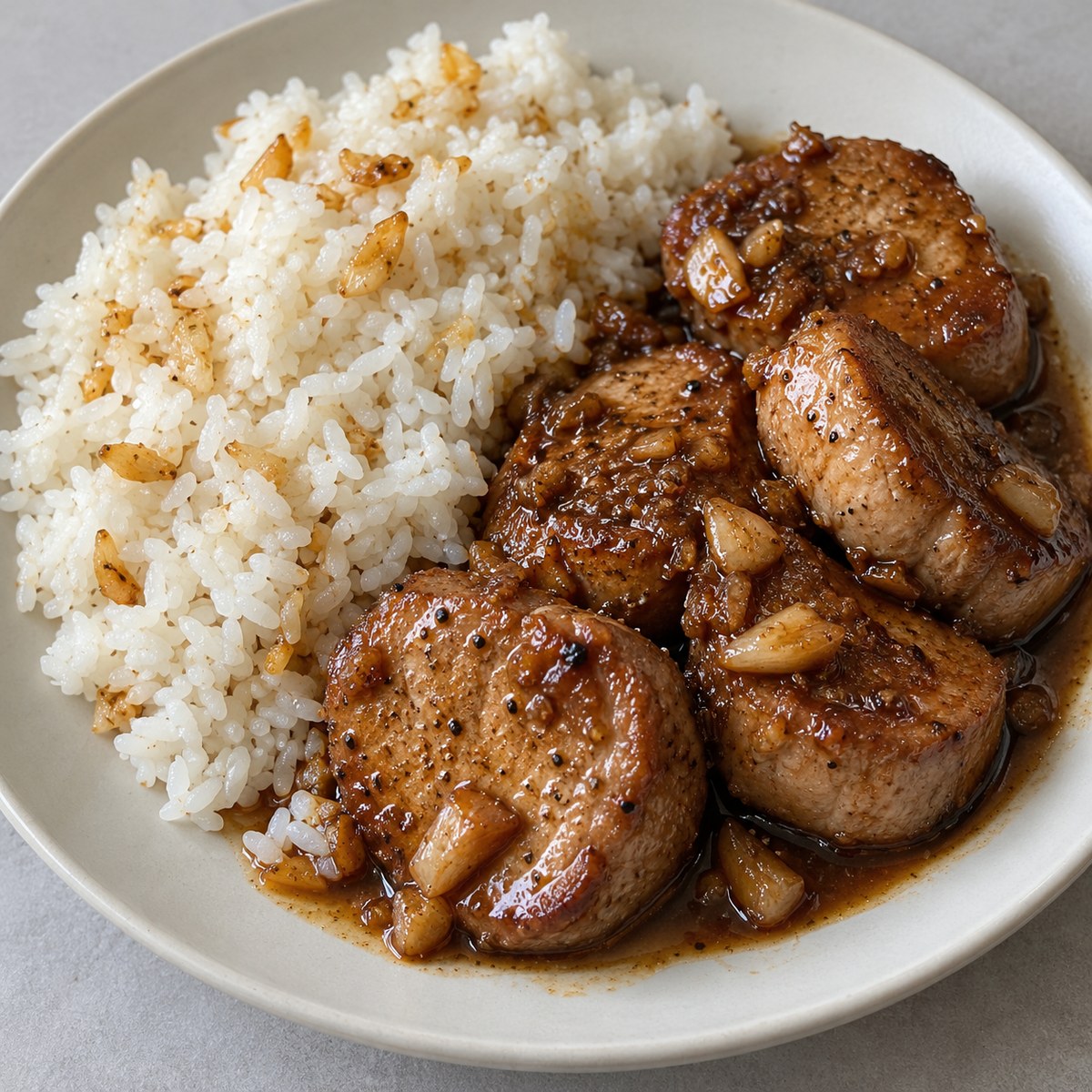
Thick pork medallions finish gently in a tangy garlic-soy sauce, served over freshly cooked rice folded with golden garlic.
The recipe
Pork Tenderloin Adobo with Garlic Rice
Thick pork medallions finish gently in a tangy garlic-soy sauce, served over freshly cooked rice folded with golden garlic.
Ingredients
- 450 g raw pork tenderloin, edible weight after removing silver skin
- 225 g dry long-grain white rice
- 60 g white distilled vinegar, 5% acidity
- 45 g soy sauce
- 30 g raw peeled garlic: 15 g crushed and 15 g finely chopped
- 2 g coarsely ground black pepper
- 550 ml water: 400 ml for rice and 150 ml for sauce
- 25 g neutral cooking oil: 15 g for garlic and 10 g for pork
Estimated recipe cost
$11.37 for 3 servings · $3.79 per serving
US grocery planning estimate in USD. Includes the amounts used from the listed ingredients, including pantry items. Prices and portion weights vary.
Ingredient-by-ingredient breakdown
| Ingredient & price basis | Cost used |
|---|---|
| 450 g raw pork tenderloin, edible weight after removing silver skinPlanning assumption · $4.00 / 454 g · Uses 450g | $3.97 |
| 225 g dry long-grain white riceRetail benchmark · $1.77 / 907 g · Retail reference · Uses 225g | $0.44 |
| 60 g white distilled vinegar, 5% acidityPlanning assumption · $2.50 / 500 ml · Density assumption: 1g/ml | $0.30 |
| 45 g soy sauceRetail benchmark · $1.68 / 444 ml · Retail reference · Density assumption: 1.16g/ml | $0.15 |
| 30 g raw peeled garlic: 15 g crushed and 15 g finely choppedRetail benchmark · $0.72 / 30 g · Retail reference · Uses 30g | $0.72 |
| 2 g coarsely ground black pepperPlanning assumption · $3.00 / 85 g · Uses 2g | $0.07 |
| 550 ml water: 400 ml for rice and 150 ml for saucePlanning assumption · $3.00 / 300 g · Density assumption: 1g/ml | $5.50 |
| 25 g neutral cooking oil: 15 g for garlic and 10 g for porkPlanning assumption · $4.00 / 454 g · Uses 25g | $0.22 |
| Estimated total | $11.37 |
Retail references are representative products, not quotes for every variety. Other prices are editorial planning assumptions. Checked 9 October 2026; these are not live prices.
Price bases and quantity assumptions refer to the original recipe. Unspecified quantities use the assumptions shown above. Listed optional ingredients are included. Unlisted sides, extra seasoning, tax, energy and delivery are excluded. Buying full packages will cost more.
Instructions
- Prepare the garlic as listed. Cut the trimmed pork across the grain into medallions about 3 cm thick, keeping any small end pieces together for easier handling. Pat the meat thoroughly dry.
- Put the dry rice and 400 ml water in a small saucepan with a tight-fitting lid. Bring to a boil, cover and reduce the heat to its lowest setting. Cook for 15 minutes, then remove from the heat and leave covered for 10 minutes. The rice should be tender with no pooled water.
- While the rice cooks, combine the vinegar, soy sauce, 150 ml water, crushed garlic and black pepper in a separate small saucepan. Bring to a boil, then simmer uncovered for 10 minutes. Keep the sauce at a very low simmer while you prepare the pork.
- Put 15 g oil and the finely chopped garlic in a wide frying pan over medium-low heat. Cook for 3–5 minutes, stirring frequently, until pale golden. Immediately scrape the garlic and its oil into a heatproof bowl; the garlic will darken slightly as it cools.
- Add the remaining 10 g oil to the frying pan and heat over medium-high heat. Lay in the pork in a single layer and sear for 90 seconds per broad side. Work in two batches if needed, allowing about 6 minutes total for searing.
- Reduce the heat to low and carefully pour the hot sauce into the pork pan. Gently simmer for approximately 3–7 minutes, turning the medallions once. Check the thickest pieces with a thermometer and remove each as it reaches 63°C; small end pieces may finish sooner. Rest the pork on a clean plate for at least 3 minutes. See the [official safe minimum temperature chart](https://www.foodsafety.gov/food-safety-charts/safe-minimum-internal-temperatures).
- While the pork rests, fluff the cooked rice and fold in all the browned garlic and its oil. If the sauce seems thin, simmer it without the pork for 1–2 minutes; keep it pourable rather than reducing it to a salty glaze.
- Divide the garlic rice among three plates. Add the rested pork and spoon the sauce over the medallions. This recipe has not been kitchen-tested; use the temperature and texture checks alongside the timing estimates.
Storage and reheating
Store pork and rice separately. Refrigerate pork within 2 hours, or within 1 hour above 32°C, and keep the fridge at 4°C or below. Use pork and sauce within 3–4 days and reheat to 74°C. Cool rice quickly in shallow portions and refrigerate within 1 hour; use within 24 hours and reheat only once, until steaming hot throughout and reaching 74°C. Sources: [FoodSafety.gov leftovers guidance](https://www.foodsafety.gov/food-safety-charts/cold-food-storage-charts), [USDA leftovers guidance](https://www.fsis.usda.gov/food-safety/safe-food-handling-and-preparation/food-safety-basics/leftovers-and-food-safety), and [FSA rice guidance](https://www.food.gov.uk/safety-hygiene/home-food-fact-checker).
Substitutions and ingredient notes
Replace the distilled vinegar with the same weight of unseasoned rice vinegar at 5% acidity. For a wheat-free version, use the same weight of certified gluten-free tamari, checking its label and saltiness. Soy sauce commonly contains soy and wheat; tamari usually still contains soy. Check all condiment labels for relevant allergens.
Estimated nutrition
556 kcal · 40g protein · 64.6g carbohydrate · 14.3g fat · 1.4g fibre per serving.
Calculated from measured ingredients and generic composition data. Brand choices and substitutions change the estimate.
Storage references: USDA leftover guidance · FSA food guidance
Recipe images may be AI-generated illustrations. Nutrition figures are estimates.